Martha and the Doll

IMG_4050

*

It’s a particularly dull day for photographs.  The light is poor and there is an irritating drizzle in the air.  Folk have stayed at home or are venturing, with heavy reluctance, only as far as their shopping needs dictate.  It’s February; a month of meagre pickings, low in inspiration, high in desperation, and one winter month more than most folk can stand.  These are days for antidepressants and undertakers, days of whining and blocked noses, days to be slept through, suffered, survived.  It’s a beige and grey sort of day, in which colours struggle to vibrate and not much contrasts much with anything, the sort of day when litter looks interesting in a desert of gloom.  February.  Not a month for images to amaze the eye.

Martha treads the dreary ways of town with quiet and humble feet.  She wears her sorrows round her shoulders in black bedraggled imitation fur, and between her naked sandalled toes in grimy crevices.  Old and free, of teeth, of obligation, she shuffles the streets, as she used to do when she did not have a home, as she has always done.  Martha likes to think outside the box.  Indoors she is unhappy, restless, lonely; a fish out of water, deprived of life.  Walls stifle and depress her.  Surfaces demand cleaning.  People want to come round and mend things.  Windows blur the beauty of the sky.  There is no air, and worrying things in envelopes insist themselves, clattering, through her door.  Martha’s sorrows, the tales of which are for another time, or maybe never, are more than many folk could bear, yet still she walks, as if there were somewhere to go, somewhere perhaps where there may still be joy to be found.

What Martha likes, more than ordinary things, more than money or appearances, what Martha cares about the most, is animals.  She sends money to donkeys in distant lands, and prays for them.  She goes to church at Christmas to see the Nativity donkey, and strokes him with the same gentleness and innocence that children show to little things.  You will see her standing by the bridge sometimes, watching the ducks, peering through the chicken wire at the merry hens running free in the field by the graveyard.  Sometimes there are horses there, and honking geese.  Many chilly hours will pass as Martha stands observing the animals and the chattering, flapping, friendly birds, wondering if they have enough to eat, wondering whether they are warm enough.  The ghost of her faithful, long dead, long-suffering dog walks along with her wherever she wanders, adhered to her ankles for always.  Stay, she had said, and so he did.

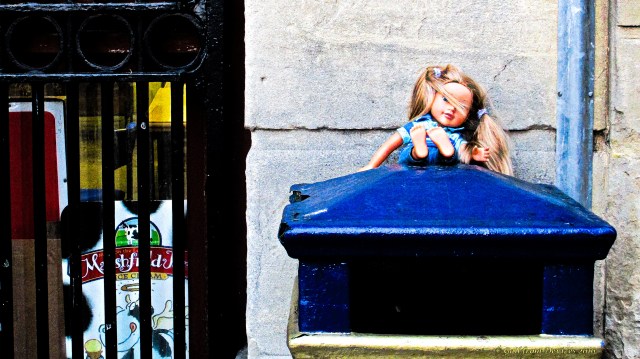
She is sitting on the top of the litter bin without a coat, her little toes all rosy in the air, dressed for summer in tomboy tee shirt and trousers.  Her eyes are blue and her lips are pink.  She has mischievous strands of blonde escaping messily from her long pigtails.  She’s pretty, and poignant, and lost.  The photographer, grateful for the surprise of an interesting subject, stops at this oasis of visual delight to drink.  Snap, click, one with the doll and the bin and the bars of the Shambles gate, one close up, one further away, one portrait shot and three for luck, quickly, before some crying child returns to snatch up the doll and cuddle her close.  The photographer was never one for toys, or plastic, or cute things.  This doll, though, she’s kind of special.  There is some glint of humour in her almost human expression and the hint of a smile on her mouth.  Across her chubby pink cheeks flicks the nuance of a personality.  She has a lovely face.  Someone will miss her, thinks the photographer, putting her satisfied camera in her pocket.  After a brief moment of hesitation, during which she contemplates adoption, she leaves the little doll on the litter bin to be found.

There is not much left to do in town.  What scant light exists within this ordinary day is dimming fast.   The photographer wanders aimlessly for a while, buying cigarettes and lipstick and cleaning things that she will never use.  She looks forward to going home and playing with the photos of the doll on her computer.  Perhaps I will post a picture on the internet, she thinks, and see if anyone knows who the doll belongs to, thereby satisfying my own ego and the purposes of altruism in one artistic act.  Not that I’m pretentious or anything.  Much.  Mostly.  Maybe.  But then what use would my picture be if the doll has gone?  She wished that she had picked her up now, and handed her in to the police station or the library.  Someone might just throw the little doll away.  Or she might get hypothermia from sitting on the bin all night.  Or someone really mean might take her home.  The delight she gleaned from capturing the image of the doll fades as she ruminates, and she regrets deciding against rescuing the doll.  She feels guilty, as she did when she was young and less than kind to teddies.  She wanders in to Smiths to see if the purchase of an unnecessary object will afford any comfort from her nagging conscience.

“Oh,” she says, smiling “you picked her up then!”  For there, by the magazines, is Martha, and there, in Martha’s gentle hands, is the doll.  “What do you mean?” says Martha, looking worried as if she might be in some sort of trouble.  “The little doll, I’ve just taken some pictures of her.”  “Have you, can I look?”  The photographer shows her the pictures in her camera.  Martha looks at them with fascination, as if they were magic.  “Such a shame,” says Martha “someone just left her there, all by herself.”  She shows the photographer the doll’s tiny bare toes, stroking them to warm them up.  “And she has no shoes on, all on her own in the cold with no shoes or coat, not nice for her at all.”  “Someone must have lost her.” “No, I don’t think so, she’s been in a sale.” She points out a paper tag in the doll’s dishevelled hair, on which ‘£3’ is faintly scrawled.  “She has alopecia” remarks the photographer, flippantly, regretting the comment immediately. “She’s got what?” says Martha, whose wisdom does not lie in words.  “It means that she has a bit of hair loss.  What are you going to do with her?” “I’m going to take her home and look after her.  Poor little thing, all lost and lonely and cold.  It’s not fair, it’s not fair at all.  She needs to be in the warm, all warm and safe, with new clothes and shoes and her hair brushed.  She’s a lovely little thing.  It’s not fair on her.  Fancy someone just leaving her like that.  On a bin, like rubbish.  It’s not right, not right at all.”  “What are you going to call her?”  Martha thinks carefully.  “I don’t know.”  She holds the doll tight to her chest.  It doesn’t seem to mind the bedraggled coat at all.  It even seems, although it must be a trick of the artificial light, to smile.  “I hope she’ll be happy with you, Martha” says the photographer, and goes down the aisle in search of superfluous pens.  From the end of the shop she can hear Martha talking to the shop assistant “Have you got a carrier bag that I can put her in, no, not that one, that’s too small, she won’t be comfortable, do you have a bigger one, yes, that will do, she’ll fit nicely in that one, thank you, thank you very much.”

It is a week or two before the photographer sees Martha again.  Hours spent trying to edit the photographs had not been well spent.  Somehow, with all the tweaking of contrast and clarity possible, she had not been able to do the doll justice with her editing programme.  The image sits in her computer, waiting patiently to be perfected.  Martha is in Smiths again, without the doll but with cheerful bright eyes, freshly washed hair and her best earrings on.  “How are you, Martha, and how is the doll?”  “Oh, she’s very well,” says Martha, smiling, “she’s sitting on the settee at home.  She’s warmer now, poor pretty little thing, it wasn’t right you know.”  “I’m glad,” says the photographer “I wanted to ask you, I wonder if you would mind if I wrote about it, you know, you and the doll, just a little piece to go with the photograph, I can change your name if you like?”  Martha looked thoughtful.  “And what would you do with it?”  “I don’t know yet, I haven’t decided, but I thought it would be a nice thing to write about.  Such a lovely doll.”  “Yes,” said Martha “you write what you like.  Poor little thing.  No shoes on.  Left out in the cold.  Not fair.  Not fair at all.”  And off walks Martha, with a spring in her step and the faithful ghost of her dog at her ankles, finally and unexpectedly finding herself with a good reason to go home.

*

© Gail Foster 2016 


Here Speaks The Magic Work Of Raymond John

Inspired by the writings of Raymond John Burt…


Here speaks the magic work of Raymond John

Intrigue in reference, delight in phrase

I’m curious as to what, my friend, you’re on

That powers your pen to so the mind amaze

Let he that has an ear be still and hear

Let she who has an eye seek out the light

For here some crazy wisdom doth appear

On wild wings of angels in the night

For Love and God and Death and Grace and Hell

Within your words take buttered toast and tea

More syllabub, Beelzebub?  Pray tell

What syllables might set the Sibyls free

Get thee behind me, ghosts, take flight, be gone!

Here speaks the magic work of Raymond John


© Gail from Devizes 2016


Farewell Father Jack; a clerihew

Father Jack is a character in an English/Irish sitcom called Father Ted, which is about Catholic priests living on an island. The joke of Father Jack is that he is always drunk and, when he is not being hidden from visiting clergy, just sits in his chair spitting expletives. Today Frank Kelly, the actor who played him so brilliantly, died. The English clerihew is a good form with which to pay him tribute.

So, farewell then, Father Jack
Let this be writ upon a plaque
“All things pass;
Drink, feck, arse…”

by Gail

Let Me In


Knock, knock, who’s there, and art thou friend or foe?

Why knockest thou at this ungodly hour?

I am the Light, whose face and word you know

I bring you sheaves of blossom trees in flower

So many moons have passed since we last met

How shall I know that it is really you?

I am the Light no darkness can forget

I bring you skies of bright and endless blue

Why comest thou, now I am nearly old

With fainting faith and blood flow slow and dry?

I am the Light, returning as foretold

I bring you Life, to raise you true and high

How glad am I, to see you at my door

Come, cast your crazy sunbeams on my floor


by Gail


Blossom Rising

On the deaths of Major John Cairns Bartholomew, of Wadworthshire,

and a much loved Devizes tree…

*

IMG_3829

*

Beneath a grey and monumental sky

In wild confetti clouds that dance in air

The blossom falls, all trees and men will die

However good, or beautiful, or rare

For years beneath the branches of that tree

Have lovers kissed and lonely mourners waited

All men and trees shall die, he, thee, and me

By that same force destroyed and yet created

The clattering of horses’ hooves, the sound

Of yeoman passing, ghosts that haunt the ears

All trees and men be gone into the ground

Till from the light new word of life appears

In red Victorian brick and petal glow

Are strength and beauty blended for our eyes

Good men and trees in season come and go

Such knowledge is the glory of the wise

Drink with your eyes each bright delight you see

And savour every moment of creation

For man will pass, and wind will fell the tree

And wine will fall on coffins in libation

If blood still flows like sap, then drain your glass

Enjoy the fleeting sunbeam in your ale

All trees and men will die, for all things pass

All moonlight fade, and colours turn to pale

Let hops be gathered, make of sunshine, hay

Add rosebuds, and ferment a heady brew

For trees and men shall certain pass away

As dark of midnight shadows summer’s blue

And soon enough, last orders will be rung

Sad flags will flutter half way up the mast

And dark laments for men and trees be sung

And rest be found for dear old souls at last

Learn wisdom, child, from ale and wood and bone

Brew love in barrels down in cellars deep

And find it there when you return, alone

To watch the man in blossom rise from sleep

*

by Gail

The Curious Offering of the Sacristan

thecuriousofferingofthesacristan - Copy

*

The curious offerings of sacristans

Are given in obscure humility

The symbol of the cupping of the hands

Enshrines the essence of this mystery

The dawn unlocked; the turning of a key

The mystic world behind the little door

The mourning weepers, watching, silently

The quiet foot upon uneven floor

The layered shadowed centuries; the pass

Of long dead worshippers before the throne

Slow shifts of coloured pools of stains of glass

Soft drift of latticed light on pillar stone

The empty candle, thirsting for new oil

Unscrewed and filled, screwed up again and lit

The hidden corners, carved by masons’ toil

In which a wary flickered flame may flit

The covering, uncovering; each fold

Of linen and of altar cloth an art

Within the starch of white, on marble cold

The space to hold His living, beating heart

Here, understated wafers wait in line

For blessing, as an unblessed congregation

Here silver, water, light, and red wine shine

Anticipating sacred consecration

Here eye, and hand, and mind, seek symmetry

In objects placed, in psychic ebbs and flows

Seek that perfection only God can see

In right angle and scented mystic rose

When all are done and gone, her hands will shake

The fragments of His flesh on holy ground

Shed drops upon the earth its thirst to slake

Pour water through the light without a sound

When all are gone, all blessed with wine and bread

There, in the East, where better men have trod

She kneels and presses to the step her head

And, lost in awe, she speaks these words to God

I am that ancient soul you always knew

A part of you, from when time first began

The I am that I am, the that in you

That serves thee, as I will, while still I can

I come to you as Christian, Muslim, Jew

Agnostic, Gnostic, Druid, Angel, Man

In the cupping of my hands I give to you

The curious offering of the sacristan

© Gail Foster 2016

*

This poem has been chosen as Poem of the Month at Sherborne Abbey

I’m thrilled


Dear Old Johnny Walter

IMG_3892 - Copy

*

Here comes Johnny Walter, the old geezer on the bike

When he waves and says “Hello there” there’s not much not to like

He is kind and he is funny, and he’s full of Wiltshire wit

He remembers everybody’s name and gets about a bit

For a man of nearly eighty his humour is quite dry

Never underestimate the twinkle in his eye

A Moonraker, a character, an ancient Briton, he

Who reckons that his ancestors lived in Avebury

A child of New Park Street, who heard and smelled and saw

The weary trains of soldiers marching homewards from the war

Who, when he was a teenager, learned how to spin a spool

And hung out at The Palace, and was far too cool for school

Imagine all the movies that he showed throughout the years

How he moved an auditorium to laughter, shock and tears

Fifty years of pictures, all those newsreels and Bond

Folk walking home from Psycho, getting spooked out by the pond

Folk snogging in the back row, swapping hormones, spit and smoke

The porn, the pot, the popcorn, and the icecream, and the coke

Johnny hung out with the Mods, and took a scooter trip to France

And liked to watch the ladies, with a beer, at a dance

Until he married Margaret; ‘twas as his father said

“If you take her to the bedroom, you will end up in the bed”

Johnny didn’t mind at all when she with child fell

First came little baby Michael, and then Carolyn as well

And the cottage, out in Cheverell, where flowed a little stream

Happy years of family, a rural rosy dream

Until the day that Margaret was taken far too soon

Leaving Johnny on his own, to marvel at the chilly moon

He kept calm, and carried on, ‘cos he’s a solid sort of guy

Kids to bring up, work to do and not much time to cry

But to this day he misses her, puts flowers on her grave

One could call him stoical, or practical, or brave

Yet in his quiet moments, sometimes, silent tears fall

Better to have loved, he thinks, than not have loved at all

Kept calm and carried on, and bore his lot with love and grace

Always greeting friends with a bright smile on his face

He stirred the jam at Easterton, rang all the village bells

He filled the air with music and with sweetened fruity smells

He’s still batty in a belfry, still a jammy sort of cove

You’ll see him with his faithful dog, with whom he likes to rove

You might think he’s a boy racer, in his go fast stripy car

He knows who’s who, and who does what, and where wild flowers are

He has grandchildren, great grandchildren, a garden, and some fish

He has the sort of life for which most decent folk would wish

He is full of Wiltshire wisdom, in a quiet sort of way

You’ll see him thinking carefully about what he should say

When he meets you in the street, and doffs his syrup and his hat

And asks after your family, your garden, and your cat

He has some little sayings, gleaned from years of Wiltshire lore

But doesn’t always understand what certain words are for

He can sometimes drop a clanger, with no malice or intent

And once he even asked me what ‘bisexual’ meant

“We’re all different” he says, “it just don’t do to be the same

Tubs should rest on their own bottoms, for the best chance at the game”

He is a loyal friend to many, and a much belovéd Dad

Just the kindest lovely man that Wiltshire ever had

 ‘Tis true that good things come in some unusual disguises

Like dear old Johnny Walter, gentle spirit of Devizes

 *

by Gail