What will be left of Gaza then but dust
And silent echoes in an empty space?
The war against Hamas, he said, was just
His wily smile the answer on his face
What of the little children, the unborn
The doctors, and the journalists who tried
To save them, and record another dawn?
It is because Hamas, he said, they died
Would not the Jews who perished long ago
In Germany and Poland in the camps
Decry this genocide, the winds that blow
The light out from so many other lamps?
You lie, he said. And then the truth appeared
There was no Gaza when the dust had cleared
© Gail Foster 22nd August 2025
Truth
John Simpson at Devizes Arts Festival

John Simpson at the Corn Exchange, Friday 31st May
One would expect a reporter of John Simpson’s standing and experience to be very careful and specific with his choice of words.
Simpson has been with the BBC for 52 years and has reported on 47 wars. He is a man whose words are to be listened to, and on Friday night a packed house at the Corn Exchange were curious and enthusiastic to hear what he had to say and ask him questions about his long career and the state of the world as we know it today.
The man is all bon homie and old school decency, and one suspects that his affability and fair manner have got him out of many a sticky situation. He starts off light, laughing about being punched on his first day on the job and being mistaken for David Attenborough, and chatting about family. He has a book to promote but avoids saying much about that at all.
He talks about the BBC, saying that these days there is opposition from all sides towards the organisation and that he’s never been told to tone it down in all the years he has worked for them. He talks about Trump, his ‘habit of tweeting insanities’ and strategy of giving away positions and key elements before presenting final agreements as amazing victories. He’s disappointed that the 30th anniversary of the Tiananmen Square protests will be overshadowed by Trump’s visit to the UK. He says that Gaddafi was off his head, that Saddam Hussein scared him, and that al-Bashir was weak and wanted to be liked. He liked Thatcher, although ‘When she was good she was very very good and when she was bad she was something else’. He says that Mandela treated people as the best version of themselves and waxes lyrical about his admiration for Václav Havel. He acknowledges that China is to be taken very seriously indeed and thinks that the best strategy is to keep it in play. China is, says Simpson, surprisingly open and anxious to be part of the international community.
He saves his most emotive words for how he feels about Britain today. ‘The line of confrontation’ he says, ‘is very disturbing indeed’. He compares the UK to France in the 50s, which was, he says ‘extraordinarily violent’. He says that there is a ‘vicious divide which stirs up the weakest intellects’. He talks about the ‘disgraceful’ messages that his colleague Laura Kuenssberg gets on social media and says that he holds social media responsible for the current ‘nastiness and violence’, for which he gets a round of applause. He refers to ‘disturbing threats to freedom’ and says that he feels more able to talk freely about other countries than our own these days. He’s dismayed to see our reputation plummet in the eyes of the world. ‘It’s painful to find that Britain has become an international joke’ and ‘It’s important to realise the way we’ve damaged our country’.
He wonders if Brexit was ‘the tinder that started the whole performance’ but stops short of apportioning blame to any particular entity. ‘This Brexit business is going to change things’ he says sadly, wishing that we could be ‘back the way we were before all this started’.
There are points where Simpson catches himself just before he falls into an abyss of pessimism and says something about hope. He does, after all, have a young son to be optimistic for. Terrorism is 7 or 8% of what it was in the seventies, he says, and a billion have been lifted out of poverty in the past 13 years. But when it comes to Britain he struggles to find any positives at all, and this from a man like Simpson is disturbing. ‘We need to try and be less divisive ourselves and more accepting of other points of view’, he says, wishing for the best but sounding as if he is whistling in the wind.
He sticks rigidly to his three-quarter hour talk and fifteen-minute Q&A plan, but then he didn’t get where he is today by faffing about. Those who wanted endless war stories are disappointed, but those who wanted his views on current situations are not. He signs books afterwards and is very approachable.
I ask people what they thought of the great man. ‘His description of Mandela – it revealed that what we all hoped to be true of him actually was’ says one audience member. ‘Honest’, ‘Genuine’, ‘Empowering’, and ‘Awe-inspiring’, say others. ‘I was sitting there thinking what have I done with my life’ says my friend. The general feeling is that it has been a privilege to hear John Simpson speak, and that people have been delighted by his wit.
And then off he goes, with shrapnel in his side and a shard of hope in his heart, to his next adventure.
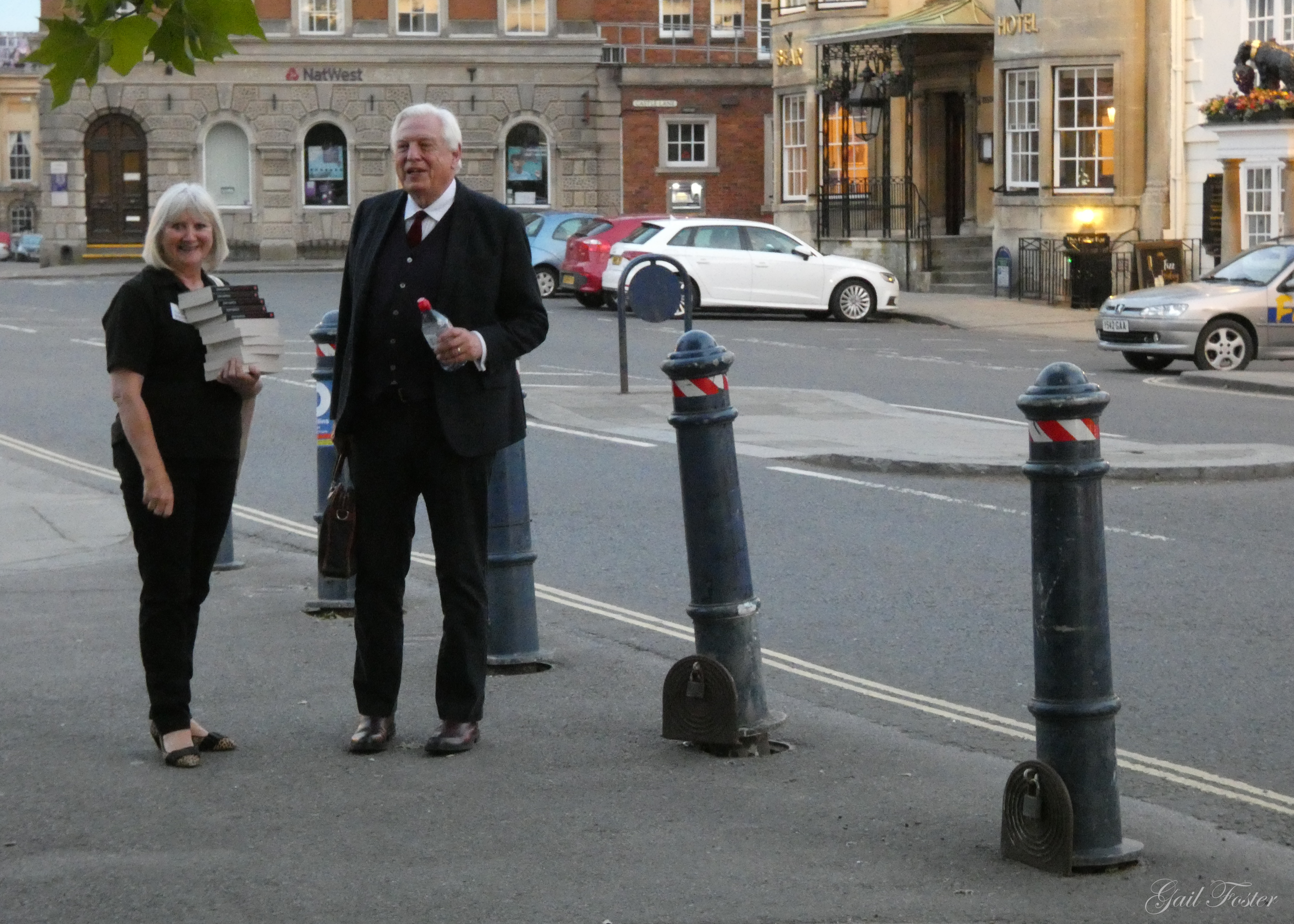
In the Market Place I take a picture of him smiling.
© Gail Foster 3rd June 2019
If Truth Be Told

A Villanelle
*
The men that catch my eye these days are few
The ones that do are married men, or mad
And truth be told I only fancy you
…
I doubt that in the pub or porch or pew
I’ll meet a man like you who makes me glad
The men that catch my eye these days are few
…
I could be looking but I seldom do
There’s only you for me, you ‘lucky’ lad
If truth be told I only fancy you
…
Until the day fate sends me someone new
I’m all for you, I know, it’s odd, and sad
But men that catch my eye these days are few
…
You make me happy, boy, you make me blue
I hold a torch for you, and I grow mad
For truth be told I only fancy you
…
I’ve told you something you already knew
I’m sorry, but I’ve really got it bad
The men that catch my eye these days are few
If truth be told I only fancy you
*
© Gail Foster 21st July 2017
Why Deal With Truth When Lies Will Do
Vote Theresa, and you may
See Brexit worries fly away
On fluffy clouds of pink and blue
Why deal with truth when lies will do
…
Vote Theresa, get behind
The flying pigs all flying blind
We’re just a turd on Europe’s shoe
Why deal with truth when lies will do
…
Vote Theresa, have it hard
She’ll get our ball from Europe’s yard
They love us really, yes they do
Why deal with truth when lies will do
…
Vote Theresa, what”s to lose
She’ll still have money for her shoes
And we’ll be in the food bank queue
Why deal with truth when lies will do
…
Vote Theresa, stable, strong
All good, and we’ll all get along
Nah, we’ll still be Europe’s twat
Hogwash, nonsense, tosh an’ that
*
© Gail Foster 3rd May 2017
The Light Is Not A Solemn Thing, It Shines

for Sarah
*
The light is not a solemn thing, it shines
With merry glee and mirthful gentleness
Will not be held a hostage, in confines
Of darkened halls where little ones confess
The sins of fathers that they never chose
Nor be a slave to chapter, scripture, verse
Be boundaried, or fettered in its flows
It is the joy of blessing, not a curse
It isn’t how you said it was. You lied
I ran, and left your lies behind the door
And here I am, and oh, the light is wide
Mysterious, and infinite, and more
A wildly wilful, free, and feisty thing
I wear a ribbon in my hair, and sing
*
© Gail Foster 26th February 2017
…
This sonnet was written for my friend Sarah, who left the Plymouth Brethren. In accordance with the Brethren’s belief in the Doctrine of Separation, those who have left are no longer allowed contact with their friends or families. In recent years former members have developed the custom of writing their loved ones’ names on yellow ribbons as a symbol of love and remembrance.
Fiona In The Night
for Fiona Meyrick, poet and musician; a Petrarchan sonnet
*
Fiona, in the silence of the night
Sings songs of sorrow soft in minor key
That sigh above all formal melody
In cadences that dance like birds in flight
She rests within the dark, composing light
In subtle shades of sweet philosophy
Transposing on the stave a mystery
In spills of sound like ink on paper bright
Fiona, at the stroke of midnight blessed
Plays pianissimo the ocean’s rage
Transforming all the sins of man confessed
In gentle rhythms traced upon the page
A modern muse, an ancient truth expressed
In lullabies to sooth our restless age
*
© Gail Foster 2016
The Mystery of Love; for Olly Michael Lancaster
I wrote this poem for my friend Mike Hopkinson’s little grandson Olly,
who will be three at the end of August
*
I am Olly Michael Lancaster, a special little lad
I love my brother Ryan, and I love my Mum and Dad
I love my funny Grandad, and I love my Nanna Sue
And we all love each other, like all happy families do
…
I like a little tickle, and a cuddle, and a rub
I like the feel of water when I’m floating in the tub
I like to giggle in the car when Grandad’s house is near
And I like it when you brush my face, and when you stroke my ear
…
I know you by your kindness, and I know you by your smell
I know you when you’re far away, and when you’re near as well
I know you by the way your pattern weaves within my heart
And I know that we are children who can only know in part
…
Oh, show me all the colours of the earth and sea and sky
Show me bright and pretty lights, and all the birds that fly
Show me shining mirrors that reflect my smiling face
And I shall show a mystery, and you shall see my grace
…
Oh, tell me tales of happiness, and joy, and fairy lands
Tell me funny nursery rhymes, and hold my little hands
Tell me all the stories that your Mum and Granny heard
And tell me all the wisdom of the world within a word
…
Oh, teach me about flowers, about butterflies, and bees
Teach me how the blossoms change to fruit upon the trees
Teach me of the moon and stars that twinkle high above
And I shall teach you with my life the secret lore of love
…
For I am yours, and you are mine, and all of us are one
I am the light in darkness and the shadow of the sun
I come to show and tell and teach the truth the ancients knew
I am Olly Michael Lancaster, and I love you
*
© Gail Foster 2016
Phoenix Rose; for Lisa Lewis
Lisa Lewis is the CEO of Doorway in Chippenham
She’s a legend. Just don’t mess with her, right…
*
Don’t mess with Lisa, she’s a scary
Far out full on punky fairy
Crowned with violent flowers and sage
And riding on her harnessed rage
Through tangled wood and thorny bower
To speak unsubtle truth to power
…
Don’t mess with Lisa, man, she’s scary
Wise be wise and fools be wary
For she will tread where no man goes
To seek those things that no one knows
Expect no mercy if you cross her
Best be right and not a tosser
…
Don’t mess with Lisa, she’s so scary
Medusa crossed with Virgin Mary
Bottle, balls, and Occam’s razor
Prosecco, throttle up, and tazer
Wild light to make a diamond shy
And tears forbidden from her eye
…
Don’t mess with Lisa, man, she’s scary
That’s one well effective fairy
Pierced with wisdom to the bone
Dark metal angel stood alone
Feared and loved by all she knows
A phoenix, from the darkness rose
*
© Gail Foster 2016
Martha and the Doll

*
It’s a particularly dull day for photographs. The light is poor and there is an irritating drizzle in the air. Folk have stayed at home or are venturing, with heavy reluctance, only as far as their shopping needs dictate. It’s February; a month of meagre pickings, low in inspiration, high in desperation, and one winter month more than most folk can stand. These are days for antidepressants and undertakers, days of whining and blocked noses, days to be slept through, suffered, survived. It’s a beige and grey sort of day, in which colours struggle to vibrate and not much contrasts much with anything, the sort of day when litter looks interesting in a desert of gloom. February. Not a month for images to amaze the eye.
Martha treads the dreary ways of town with quiet and humble feet. She wears her sorrows round her shoulders in black bedraggled imitation fur, and between her naked sandalled toes in grimy crevices. Old and free, of teeth, of obligation, she shuffles the streets, as she used to do when she did not have a home, as she has always done. Martha likes to think outside the box. Indoors she is unhappy, restless, lonely; a fish out of water, deprived of life. Walls stifle and depress her. Surfaces demand cleaning. People want to come round and mend things. Windows blur the beauty of the sky. There is no air, and worrying things in envelopes insist themselves, clattering, through her door. Martha’s sorrows, the tales of which are for another time, or maybe never, are more than many folk could bear, yet still she walks, as if there were somewhere to go, somewhere perhaps where there may still be joy to be found.
What Martha likes, more than ordinary things, more than money or appearances, what Martha cares about the most, is animals. She sends money to donkeys in distant lands, and prays for them. She goes to church at Christmas to see the Nativity donkey, and strokes him with the same gentleness and innocence that children show to little things. You will see her standing by the bridge sometimes, watching the ducks, peering through the chicken wire at the merry hens running free in the field by the graveyard. Sometimes there are horses there, and honking geese. Many chilly hours will pass as Martha stands observing the animals and the chattering, flapping, friendly birds, wondering if they have enough to eat, wondering whether they are warm enough. The ghost of her faithful, long dead, long-suffering dog walks along with her wherever she wanders, adhered to her ankles for always. Stay, she had said, and so he did.
She is sitting on the top of the litter bin without a coat, her little toes all rosy in the air, dressed for summer in tomboy tee shirt and trousers. Her eyes are blue and her lips are pink. She has mischievous strands of blonde escaping messily from her long pigtails. She’s pretty, and poignant, and lost. The photographer, grateful for the surprise of an interesting subject, stops at this oasis of visual delight to drink. Snap, click, one with the doll and the bin and the bars of the Shambles gate, one close up, one further away, one portrait shot and three for luck, quickly, before some crying child returns to snatch up the doll and cuddle her close. The photographer was never one for toys, or plastic, or cute things. This doll, though, she’s kind of special. There is some glint of humour in her almost human expression and the hint of a smile on her mouth. Across her chubby pink cheeks flicks the nuance of a personality. She has a lovely face. Someone will miss her, thinks the photographer, putting her satisfied camera in her pocket. After a brief moment of hesitation, during which she contemplates adoption, she leaves the little doll on the litter bin to be found.
There is not much left to do in town. What scant light exists within this ordinary day is dimming fast. The photographer wanders aimlessly for a while, buying cigarettes and lipstick and cleaning things that she will never use. She looks forward to going home and playing with the photos of the doll on her computer. Perhaps I will post a picture on the internet, she thinks, and see if anyone knows who the doll belongs to, thereby satisfying my own ego and the purposes of altruism in one artistic act. Not that I’m pretentious or anything. Much. Mostly. Maybe. But then what use would my picture be if the doll has gone? She wished that she had picked her up now, and handed her in to the police station or the library. Someone might just throw the little doll away. Or she might get hypothermia from sitting on the bin all night. Or someone really mean might take her home. The delight she gleaned from capturing the image of the doll fades as she ruminates, and she regrets deciding against rescuing the doll. She feels guilty, as she did when she was young and less than kind to teddies. She wanders in to Smiths to see if the purchase of an unnecessary object will afford any comfort from her nagging conscience.
“Oh,” she says, smiling “you picked her up then!” For there, by the magazines, is Martha, and there, in Martha’s gentle hands, is the doll. “What do you mean?” says Martha, looking worried as if she might be in some sort of trouble. “The little doll, I’ve just taken some pictures of her.” “Have you, can I look?” The photographer shows her the pictures in her camera. Martha looks at them with fascination, as if they were magic. “Such a shame,” says Martha “someone just left her there, all by herself.” She shows the photographer the doll’s tiny bare toes, stroking them to warm them up. “And she has no shoes on, all on her own in the cold with no shoes or coat, not nice for her at all.” “Someone must have lost her.” “No, I don’t think so, she’s been in a sale.” She points out a paper tag in the doll’s dishevelled hair, on which ‘£3’ is faintly scrawled. “She has alopecia” remarks the photographer, flippantly, regretting the comment immediately. “She’s got what?” says Martha, whose wisdom does not lie in words. “It means that she has a bit of hair loss. What are you going to do with her?” “I’m going to take her home and look after her. Poor little thing, all lost and lonely and cold. It’s not fair, it’s not fair at all. She needs to be in the warm, all warm and safe, with new clothes and shoes and her hair brushed. She’s a lovely little thing. It’s not fair on her. Fancy someone just leaving her like that. On a bin, like rubbish. It’s not right, not right at all.” “What are you going to call her?” Martha thinks carefully. “I don’t know.” She holds the doll tight to her chest. It doesn’t seem to mind the bedraggled coat at all. It even seems, although it must be a trick of the artificial light, to smile. “I hope she’ll be happy with you, Martha” says the photographer, and goes down the aisle in search of superfluous pens. From the end of the shop she can hear Martha talking to the shop assistant “Have you got a carrier bag that I can put her in, no, not that one, that’s too small, she won’t be comfortable, do you have a bigger one, yes, that will do, she’ll fit nicely in that one, thank you, thank you very much.”
It is a week or two before the photographer sees Martha again. Hours spent trying to edit the photographs had not been well spent. Somehow, with all the tweaking of contrast and clarity possible, she had not been able to do the doll justice with her editing programme. The image sits in her computer, waiting patiently to be perfected. Martha is in Smiths again, without the doll but with cheerful bright eyes, freshly washed hair and her best earrings on. “How are you, Martha, and how is the doll?” “Oh, she’s very well,” says Martha, smiling, “she’s sitting on the settee at home. She’s warmer now, poor pretty little thing, it wasn’t right you know.” “I’m glad,” says the photographer “I wanted to ask you, I wonder if you would mind if I wrote about it, you know, you and the doll, just a little piece to go with the photograph, I can change your name if you like?” Martha looked thoughtful. “And what would you do with it?” “I don’t know yet, I haven’t decided, but I thought it would be a nice thing to write about. Such a lovely doll.” “Yes,” said Martha “you write what you like. Poor little thing. No shoes on. Left out in the cold. Not fair. Not fair at all.” And off walks Martha, with a spring in her step and the faithful ghost of her dog at her ankles, finally and unexpectedly finding herself with a good reason to go home.
*
© Gail Foster 2016
Midnight Mass; St. John’s
*
Church on Christmas Eve
Experience of spirit
Secular delight
…
Candles flickering
Stirred by one communal breath
Casting bright shadows
…
The choir whispering
Mournful cadenced melodies
That bless the silence
…
Drunken folk giggling
Respectfully hiccupping
Noisy chundering
…
Strange and precious faith
The uninitiated
Wary, questioning
…
Through agnostic eyes
Such peculiar mystery
Custom, novelty
…
The truth hides in love
Ancient priests and children know
Its simplicity
…
The door is opened
Out in to the night The Word
Flies on sacred wings
…
Midnight Mass; the light
In darkness comprehending
Emptiness with joy
*
by Gail
 gailfromdevizes