*
It’s a particularly dull day for photographs. The light is poor and there is an irritating drizzle in the air. Folk have stayed at home or are venturing, with heavy reluctance, only as far as their shopping needs dictate. It’s February; a month of meagre pickings, low in inspiration, high in desperation, and one winter month more than most folk can stand. These are days for antidepressants and undertakers, days of whining and blocked noses, days to be slept through, suffered, survived. It’s a beige and grey sort of day, in which colours struggle to vibrate and not much contrasts much with anything, the sort of day when litter looks interesting in a desert of gloom. February. Not a month for images to amaze the eye.
Martha treads the dreary ways of town with quiet and humble feet. She wears her sorrows round her shoulders in black bedraggled imitation fur, and between her naked sandalled toes in grimy crevices. Old and free, of teeth, of obligation, she shuffles the streets, as she used to do when she did not have a home, as she has always done. Martha likes to think outside the box. Indoors she is unhappy, restless, lonely; a fish out of water, deprived of life. Walls stifle and depress her. Surfaces demand cleaning. People want to come round and mend things. Windows blur the beauty of the sky. There is no air, and worrying things in envelopes insist themselves, clattering, through her door. Martha’s sorrows, the tales of which are for another time, or maybe never, are more than many folk could bear, yet still she walks, as if there were somewhere to go, somewhere perhaps where there may still be joy to be found.
What Martha likes, more than ordinary things, more than money or appearances, what Martha cares about the most, is animals. She sends money to donkeys in distant lands, and prays for them. She goes to church at Christmas to see the Nativity donkey, and strokes him with the same gentleness and innocence that children show to little things. You will see her standing by the bridge sometimes, watching the ducks, peering through the chicken wire at the merry hens running free in the field by the graveyard. Sometimes there are horses there, and honking geese. Many chilly hours will pass as Martha stands observing the animals and the chattering, flapping, friendly birds, wondering if they have enough to eat, wondering whether they are warm enough. The ghost of her faithful, long dead, long-suffering dog walks along with her wherever she wanders, adhered to her ankles for always. Stay, she had said, and so he did.
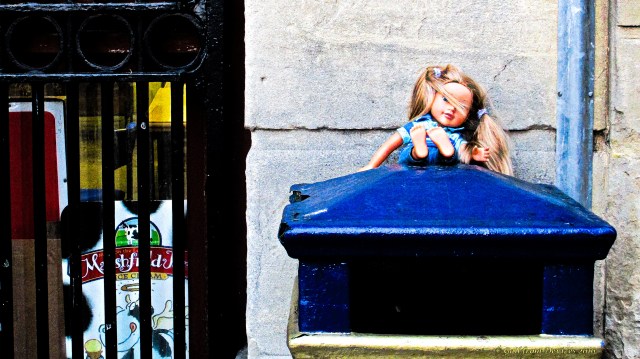
She is sitting on the top of the litter bin without a coat, her little toes all rosy in the air, dressed for summer in tomboy tee shirt and trousers. Her eyes are blue and her lips are pink. She has mischievous strands of blonde escaping messily from her long pigtails. She’s pretty, and poignant, and lost. The photographer, grateful for the surprise of an interesting subject, stops at this oasis of visual delight to drink. Snap, click, one with the doll and the bin and the bars of the Shambles gate, one close up, one further away, one portrait shot and three for luck, quickly, before some crying child returns to snatch up the doll and cuddle her close. The photographer was never one for toys, or plastic, or cute things. This doll, though, she’s kind of special. There is some glint of humour in her almost human expression and the hint of a smile on her mouth. Across her chubby pink cheeks flicks the nuance of a personality. She has a lovely face. Someone will miss her, thinks the photographer, putting her satisfied camera in her pocket. After a brief moment of hesitation, during which she contemplates adoption, she leaves the little doll on the litter bin to be found.
There is not much left to do in town. What scant light exists within this ordinary day is dimming fast. The photographer wanders aimlessly for a while, buying cigarettes and lipstick and cleaning things that she will never use. She looks forward to going home and playing with the photos of the doll on her computer. Perhaps I will post a picture on the internet, she thinks, and see if anyone knows who the doll belongs to, thereby satisfying my own ego and the purposes of altruism in one artistic act. Not that I’m pretentious or anything. Much. Mostly. Maybe. But then what use would my picture be if the doll has gone? She wished that she had picked her up now, and handed her in to the police station or the library. Someone might just throw the little doll away. Or she might get hypothermia from sitting on the bin all night. Or someone really mean might take her home. The delight she gleaned from capturing the image of the doll fades as she ruminates, and she regrets deciding against rescuing the doll. She feels guilty, as she did when she was young and less than kind to teddies. She wanders in to Smiths to see if the purchase of an unnecessary object will afford any comfort from her nagging conscience.
“Oh,” she says, smiling “you picked her up then!” For there, by the magazines, is Martha, and there, in Martha’s gentle hands, is the doll. “What do you mean?” says Martha, looking worried as if she might be in some sort of trouble. “The little doll, I’ve just taken some pictures of her.” “Have you, can I look?” The photographer shows her the pictures in her camera. Martha looks at them with fascination, as if they were magic. “Such a shame,” says Martha “someone just left her there, all by herself.” She shows the photographer the doll’s tiny bare toes, stroking them to warm them up. “And she has no shoes on, all on her own in the cold with no shoes or coat, not nice for her at all.” “Someone must have lost her.” “No, I don’t think so, she’s been in a sale.” She points out a paper tag in the doll’s dishevelled hair, on which ‘£3’ is faintly scrawled. “She has alopecia” remarks the photographer, flippantly, regretting the comment immediately. “She’s got what?” says Martha, whose wisdom does not lie in words. “It means that she has a bit of hair loss. What are you going to do with her?” “I’m going to take her home and look after her. Poor little thing, all lost and lonely and cold. It’s not fair, it’s not fair at all. She needs to be in the warm, all warm and safe, with new clothes and shoes and her hair brushed. She’s a lovely little thing. It’s not fair on her. Fancy someone just leaving her like that. On a bin, like rubbish. It’s not right, not right at all.” “What are you going to call her?” Martha thinks carefully. “I don’t know.” She holds the doll tight to her chest. It doesn’t seem to mind the bedraggled coat at all. It even seems, although it must be a trick of the artificial light, to smile. “I hope she’ll be happy with you, Martha” says the photographer, and goes down the aisle in search of superfluous pens. From the end of the shop she can hear Martha talking to the shop assistant “Have you got a carrier bag that I can put her in, no, not that one, that’s too small, she won’t be comfortable, do you have a bigger one, yes, that will do, she’ll fit nicely in that one, thank you, thank you very much.”
It is a week or two before the photographer sees Martha again. Hours spent trying to edit the photographs had not been well spent. Somehow, with all the tweaking of contrast and clarity possible, she had not been able to do the doll justice with her editing programme. The image sits in her computer, waiting patiently to be perfected. Martha is in Smiths again, without the doll but with cheerful bright eyes, freshly washed hair and her best earrings on. “How are you, Martha, and how is the doll?” “Oh, she’s very well,” says Martha, smiling, “she’s sitting on the settee at home. She’s warmer now, poor pretty little thing, it wasn’t right you know.” “I’m glad,” says the photographer “I wanted to ask you, I wonder if you would mind if I wrote about it, you know, you and the doll, just a little piece to go with the photograph, I can change your name if you like?” Martha looked thoughtful. “And what would you do with it?” “I don’t know yet, I haven’t decided, but I thought it would be a nice thing to write about. Such a lovely doll.” “Yes,” said Martha “you write what you like. Poor little thing. No shoes on. Left out in the cold. Not fair. Not fair at all.” And off walks Martha, with a spring in her step and the faithful ghost of her dog at her ankles, finally and unexpectedly finding herself with a good reason to go home.
*
© Gail Foster 2016


 gailfromdevizes