Granny’s Easter Buns

Jenny's Hot Cross buns

*

Grandad says that Easter isn’t funny

You won’t find him at parties

Dressed up as the Easter bunny

He’ll not be scoffing chocolate eggs

Or anything like that

He’ll be putting on his Sunday best

And dusting off his hat

For Grandad is an Anglican

Of serious intent

Does bible study when he can

And gave up cake for Lent

He says that Jesus died for me

And I’d best not forget it

But seeing as I’m only three

I’m sorry, I don’t get it

My Granny, now my Granny, mind

She has a different view

She leaves me little eggs to find

In places like my shoe

The smell of Granny’s hot cross buns

Is paradise and bliss

She makes me little special ones

Topped with a tiny kiss

Granny says God loves me

As she makes my Easter bonnet

With a smile as she carefully

Sews flowers and bees upon it

Let Grandad do religious stuff

The crucifixion thing

I’m only really old enough

For Granny, and the Spring

Grandad’s back from church now

Saying “Jesus rose for you”

“Well, bless us all” my Granny says

“The buns are risen too”

*

by Gail


Strange Simony


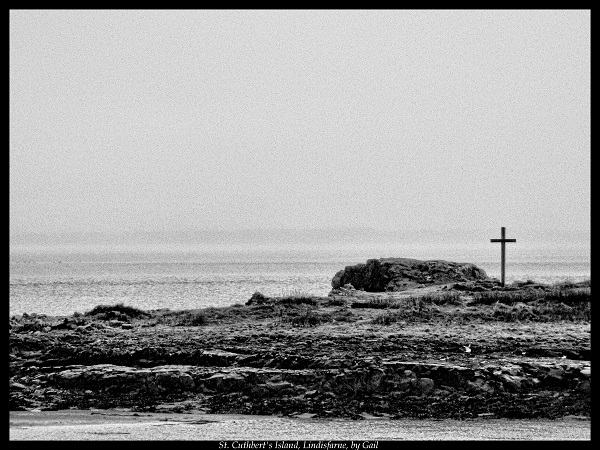
St. Cuthbert's Island


For Good Friday


Another man

Another plan

Hung on a

Godforsaken tree

One dread kiss

And then

Was this

Eternal calumny

How bitter

Seems the glitter

Of dark silver

Simony

No shining glory

In this story

Just shame

And death

For all to see

In the daylight

And with hindsight

Could not there

Light and mercy be

For it was writ

This would be it

That all these things

Would come to be

The portrayal

Of his betrayal

Haunts our own

Humanity

No kudos

For poor Judas

Only lonely

Ignominy


by Gail


She Comes

Silbury Spring

A rhyme written for the Spring Equinox

and the Gorsedd of the Bards

at Avebury, Wiltshire

*

For all the night she trod the furrowed earth

As she has walked all winter in her wake

In seeking for the child she brought to birth

The maiden bride whom Hades chose to take

The gibbous moon is waxing to the bright

And shedding shifting shadows on the lands

One single moonbeam spills down through the night

Upon the rutted earth on which she stands

Made heavy by the weight of mother’s tears

The ground beneath her feet begins to yield

The imprint of a child’s foot appears

Emerging from the darkness of the field

The dawn is tinting grey the silken skies

The lifting mist moves gulls to take the air

She swears she hears these words within their cries

She comes, she comes, she comes, is nearly there…

Around the hill of Silbury swirl the springs

From many sources meeting there as one

Upon the fence a bardic blackbird sings

His songs of seasons ended and begun

The heron stands in wait down by the brook

The willows’ leaves weave rills upon the stream

The cormorant is fishing for the rook

Whose shadow shapes a fish from daybreak’s gleam

From alder trees drip drops of ancient dew

Like shining crystals, in to waters deep

The grey of morn becomes a brighter blue

New lambs are woken from the dark womb’s sleep

A muffled drumbeat pounds within her bones

Thrills through her feet and trembles in her chest

Draws from four corners people of the stones

To stand and lay the winter to his rest

Can it be so, she thinks, that she will come

And willingly escape the thrall of Hades

Be called by this fast beating of the drum

To dance among the wild lords-and-ladies

The drum, the drum, the Druid in the East

The daylight shattering the glass of night

Behold the mead and cake that form the feast

Behold the glorious blessing of the light

The blazing gorse flames yellow on the hill

Bright shafts of sun surround the Druid’s head

She comes, she comes, my daughter liveth still

Released at last from fathoms of the dead

Her eyes are purple crocuses; her hair

Is woven through with wood anemones

She shocks the eyes, her presence is so rare

And strong, as hyacinths upon the breeze

She wears the sun a-shimmer on her dress

In folds of drops of snow and celandines

And, as befits she with the power to bless

Comes riding on a stag of seven tines

She speaks unto the awed and silent crowd

“I come” she says “I bring the fire of life

I come to cast my seeds on fields ploughed

To quell your hunger and relieve your strife

I bring you daylight from the depths of hell

Where I with Hades am forever wed

Of Christ and Dionysus I shall tell

In sacred stories of the risen dead”

The crowd are stunned to silence, robbed of breath

She came, she came, brought winter to his knees

Defied the dreadful tide of dark and death

To bless the ground with shoots, and trees with leaves

The ancient Druid offers up the cup

The wine of her libations there to sip

He bows his head, as down she stoops to sup

And touch the cup upon her rosy lip

And with this act the sunlight floods the sky

The spell is broken by the touch of earth

And Demeter runs forward with a cry

To hold the maiden that she brought to birth

The seasons come, the seasons go, and all

Shall rise and fall and fade and reappear

And Spring shall once more answer to the call

Of Hades at the dying of the year

But here, by mother love and heat of day

Persephone is made a child again

To run upon the hills; to dance and play

And plant her flowers in the world of men

*

© Gail Foster 2016
The Angel of the North

IMG_4585-1


*

Another bloody southerner

Shedding tears at my steely feet

I stand in judgement over you

See me and weep

Tell the angels of the south

To bless you with their feathered sympathy

I have no eyes to cry for you

Nor close in sleep

This is my body, glorious

Within my breast a thousand hammers beat

I cast a shadow over you

See me and weep

*

by Gail

Well, Well, Welby

Well, well, Welby

Beg your pardon

He’s got three Poles

At the bottom of his garden*

And joining in with daily prayers

Some Syrians beneath the stairs

Asylum seekers in his shed

And Communists

Beneath his bed


He’s just doing what he can

To pander to the ‘common’ man

To separate the issues, see

Of race and the economy

With good intent to bridge the gap

‘Twixt logic and the racist cr*p

For Welby is a diplomat

Just in case, and just like that


It’s not that we’re a racist state

Good luck with that one, Welby, mate

Imagine pubs across the land

The dodgy banter, beer in hand

That Archbishop got it right

We’re all white mate, we’re all white

Share our wealth with all the planet?

Outrageous! (outraged Bob from Thanet)


But what of all the fish and bread

With which five thousand mouths were fed

Would Jesus Christ have found it hard

To put up Poles in his back yard?


by Gail


* A play on the words of an English joke, “Well, well, well, three holes in the garden!”

Scatter Me

IMG_4339 - Copy


Scatter me there where the winds are sweet

To the blue of the sky and the sun’s bright heat

On Oliver’s Camp where the dragon lines meet

Scatter me there on the hill


Scatter me there where the waters flow

Where the weeping mourners come and go

Down by The Wharf where the ducklings grow

Scatter me there on the bridge


Scatter me there where the earth sees all

When the pond is lit by a moonbeam’s fall

Where the children play and the drunkards brawl

Scatter me there on the green


Scatter me there where the griffons play

Where the waters pour the hours away

In the pool of the fountain on Market Day

Scatter me there in the stream


Scatter me there with the silent dead

Where ages of souls have been buried and wed

And the angels cavort among coffins of lead

Scatter me there by the church


Scatter me there where the townsfolk cried

And strew flowers on the steps when Diana died

On the stair where ’tis said that Ruth Pierce lied

Scatter me there on the cross


Scatter me here and leave me be

On every street, under every tree

Until I am dust and memory

Scatter me here where I’m free


by Gail


Rosemary’s Funeral

Mother’s Day is an emotional time, especially for folk who no longer have their Mums around. My mother is long gone, bless her. She died at this time of year, in 1990. I wrote this last year for Mother’s Day, and the coming of Spring. It’s actually a celebration of her so no need for tears.

*

My mother’s coffin on the bier, up the cobbled steps to St. Mary’s church. My babe folded warm to my breast. Green turf on the hill and the early cry of lambs upon the Plain. Warm breath, warm wind, the knell of an ancient bell, solemn steps up to the sacred temple, dedicated to His mother, The Mother, all mothers, my mother.

For Spring is a dying in itself. My child stirs. She waited for him before her passing. I pressed him to her breast as she lay dying, her window open, bright gifted daffodils a-stirring on the sill. I took a photograph and have it still. My mother, blessed in her helplessness, still fierce in her humility, with a twinkle in her eye, a warm smile and her only grandchild in her arms.

Funeral over and back in the light my son and I await new life.

*

by Gail

Martha and the Doll

IMG_4050

*

It’s a particularly dull day for photographs.  The light is poor and there is an irritating drizzle in the air.  Folk have stayed at home or are venturing, with heavy reluctance, only as far as their shopping needs dictate.  It’s February; a month of meagre pickings, low in inspiration, high in desperation, and one winter month more than most folk can stand.  These are days for antidepressants and undertakers, days of whining and blocked noses, days to be slept through, suffered, survived.  It’s a beige and grey sort of day, in which colours struggle to vibrate and not much contrasts much with anything, the sort of day when litter looks interesting in a desert of gloom.  February.  Not a month for images to amaze the eye.

Martha treads the dreary ways of town with quiet and humble feet.  She wears her sorrows round her shoulders in black bedraggled imitation fur, and between her naked sandalled toes in grimy crevices.  Old and free, of teeth, of obligation, she shuffles the streets, as she used to do when she did not have a home, as she has always done.  Martha likes to think outside the box.  Indoors she is unhappy, restless, lonely; a fish out of water, deprived of life.  Walls stifle and depress her.  Surfaces demand cleaning.  People want to come round and mend things.  Windows blur the beauty of the sky.  There is no air, and worrying things in envelopes insist themselves, clattering, through her door.  Martha’s sorrows, the tales of which are for another time, or maybe never, are more than many folk could bear, yet still she walks, as if there were somewhere to go, somewhere perhaps where there may still be joy to be found.

What Martha likes, more than ordinary things, more than money or appearances, what Martha cares about the most, is animals.  She sends money to donkeys in distant lands, and prays for them.  She goes to church at Christmas to see the Nativity donkey, and strokes him with the same gentleness and innocence that children show to little things.  You will see her standing by the bridge sometimes, watching the ducks, peering through the chicken wire at the merry hens running free in the field by the graveyard.  Sometimes there are horses there, and honking geese.  Many chilly hours will pass as Martha stands observing the animals and the chattering, flapping, friendly birds, wondering if they have enough to eat, wondering whether they are warm enough.  The ghost of her faithful, long dead, long-suffering dog walks along with her wherever she wanders, adhered to her ankles for always.  Stay, she had said, and so he did.

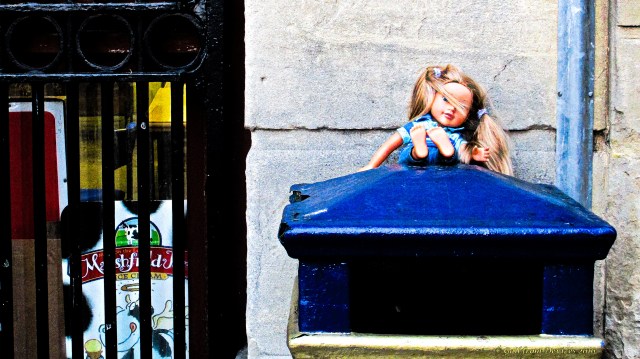
She is sitting on the top of the litter bin without a coat, her little toes all rosy in the air, dressed for summer in tomboy tee shirt and trousers.  Her eyes are blue and her lips are pink.  She has mischievous strands of blonde escaping messily from her long pigtails.  She’s pretty, and poignant, and lost.  The photographer, grateful for the surprise of an interesting subject, stops at this oasis of visual delight to drink.  Snap, click, one with the doll and the bin and the bars of the Shambles gate, one close up, one further away, one portrait shot and three for luck, quickly, before some crying child returns to snatch up the doll and cuddle her close.  The photographer was never one for toys, or plastic, or cute things.  This doll, though, she’s kind of special.  There is some glint of humour in her almost human expression and the hint of a smile on her mouth.  Across her chubby pink cheeks flicks the nuance of a personality.  She has a lovely face.  Someone will miss her, thinks the photographer, putting her satisfied camera in her pocket.  After a brief moment of hesitation, during which she contemplates adoption, she leaves the little doll on the litter bin to be found.

There is not much left to do in town.  What scant light exists within this ordinary day is dimming fast.   The photographer wanders aimlessly for a while, buying cigarettes and lipstick and cleaning things that she will never use.  She looks forward to going home and playing with the photos of the doll on her computer.  Perhaps I will post a picture on the internet, she thinks, and see if anyone knows who the doll belongs to, thereby satisfying my own ego and the purposes of altruism in one artistic act.  Not that I’m pretentious or anything.  Much.  Mostly.  Maybe.  But then what use would my picture be if the doll has gone?  She wished that she had picked her up now, and handed her in to the police station or the library.  Someone might just throw the little doll away.  Or she might get hypothermia from sitting on the bin all night.  Or someone really mean might take her home.  The delight she gleaned from capturing the image of the doll fades as she ruminates, and she regrets deciding against rescuing the doll.  She feels guilty, as she did when she was young and less than kind to teddies.  She wanders in to Smiths to see if the purchase of an unnecessary object will afford any comfort from her nagging conscience.

“Oh,” she says, smiling “you picked her up then!”  For there, by the magazines, is Martha, and there, in Martha’s gentle hands, is the doll.  “What do you mean?” says Martha, looking worried as if she might be in some sort of trouble.  “The little doll, I’ve just taken some pictures of her.”  “Have you, can I look?”  The photographer shows her the pictures in her camera.  Martha looks at them with fascination, as if they were magic.  “Such a shame,” says Martha “someone just left her there, all by herself.”  She shows the photographer the doll’s tiny bare toes, stroking them to warm them up.  “And she has no shoes on, all on her own in the cold with no shoes or coat, not nice for her at all.”  “Someone must have lost her.” “No, I don’t think so, she’s been in a sale.” She points out a paper tag in the doll’s dishevelled hair, on which ‘£3’ is faintly scrawled.  “She has alopecia” remarks the photographer, flippantly, regretting the comment immediately. “She’s got what?” says Martha, whose wisdom does not lie in words.  “It means that she has a bit of hair loss.  What are you going to do with her?” “I’m going to take her home and look after her.  Poor little thing, all lost and lonely and cold.  It’s not fair, it’s not fair at all.  She needs to be in the warm, all warm and safe, with new clothes and shoes and her hair brushed.  She’s a lovely little thing.  It’s not fair on her.  Fancy someone just leaving her like that.  On a bin, like rubbish.  It’s not right, not right at all.”  “What are you going to call her?”  Martha thinks carefully.  “I don’t know.”  She holds the doll tight to her chest.  It doesn’t seem to mind the bedraggled coat at all.  It even seems, although it must be a trick of the artificial light, to smile.  “I hope she’ll be happy with you, Martha” says the photographer, and goes down the aisle in search of superfluous pens.  From the end of the shop she can hear Martha talking to the shop assistant “Have you got a carrier bag that I can put her in, no, not that one, that’s too small, she won’t be comfortable, do you have a bigger one, yes, that will do, she’ll fit nicely in that one, thank you, thank you very much.”

It is a week or two before the photographer sees Martha again.  Hours spent trying to edit the photographs had not been well spent.  Somehow, with all the tweaking of contrast and clarity possible, she had not been able to do the doll justice with her editing programme.  The image sits in her computer, waiting patiently to be perfected.  Martha is in Smiths again, without the doll but with cheerful bright eyes, freshly washed hair and her best earrings on.  “How are you, Martha, and how is the doll?”  “Oh, she’s very well,” says Martha, smiling, “she’s sitting on the settee at home.  She’s warmer now, poor pretty little thing, it wasn’t right you know.”  “I’m glad,” says the photographer “I wanted to ask you, I wonder if you would mind if I wrote about it, you know, you and the doll, just a little piece to go with the photograph, I can change your name if you like?”  Martha looked thoughtful.  “And what would you do with it?”  “I don’t know yet, I haven’t decided, but I thought it would be a nice thing to write about.  Such a lovely doll.”  “Yes,” said Martha “you write what you like.  Poor little thing.  No shoes on.  Left out in the cold.  Not fair.  Not fair at all.”  And off walks Martha, with a spring in her step and the faithful ghost of her dog at her ankles, finally and unexpectedly finding herself with a good reason to go home.

*

© Gail Foster 2016