Colin’s Garden

For Colin Hopgood, a good man of Devizes, who has been milkman and Mayor, and tends the allotment by Quakers Walk that gives so much pleasure to so many…

*

‘Tis Spring on the allotments, in the air

The scent of hyacinths, the sense of bees

The sunlight on the cabbages and trees

And sitting in the greenhouse, on his chair

Remembering past summers, and the Fair

The Kenyan heat, the icy Kennet freeze

The smallest seedlings grown into sweet peas

Is Colin, father, lover, milkman, mayor

He’ll tell you, if you ask him, where the boat

That sits amongst the marigolds once sat

He’ll show you his banana tree, and bowers

And time and swans will fly, and barges float

Until he calls his dogs, and doffs his hat

And sends you home with vegetables, and flowers

*

© Gail Foster 23rd March 2017

The Old Lights Of Christmas

swan

Devizes, Wiltshire; New Year’s Eve…

*

The cyclist sees, in the edge of her eye

Fireworks flash in the distant beyond

Ghostly swans on the dark of the pond

The old lights of Christmas go glittering by

The cyclist sees, in the edge of her eye

Houses shimmer with sparkling rain

Curtains drawn on sorrow and pain

The old lights of Christmas go glittering by

The cyclist sees, in the edge of her eye

Stars wheel over the Market Place

The shift of a shadow on Ceres’ face

The old lights of Christmas go glittering by

*

© Gail Foster 31st December 2016

Many Mansions; for Sister David Lewis

sister-david-on-her-birthday-2

Photograph of Sister David Lewis reproduced by kind permission of Scott Coleman

Sister David Lewis taught for many years at St. Joseph’s Catholic Primary School in Devizes in Wiltshire, and will be remembered by many with affection and gratitude. 

*

I’m crying for a Catholic nun

Who once was kind to me

As I sat there in my miniskirt

Bad mother, C of E

“Sister David, the police came round

And battered down the door”

“Well, do you know, my dear,” she said

“I’ve heard that one before”

And she blessed me, without blinking

With a smile on her face

And I knew I was forgiven

Hail Mary, full of grace

And I can hear as clear as day

The words she said to me

“In my father’s house, my dear,

There many mansions be”

*

© Gail Foster 29th December 2016


Green Tears for Beauty

img_1137

*

for jemma brown and the invitation theatre company
on the occasion of anthony brown’s production
of ‘war of the worlds’, at st. mary’s in devizes

*

a mellifluous light

cello ripe and butter sweet

slides through the silence

a river of silver

flute bright and sugar spun

streams through the shadows

forever the autumn’s

melancholy melodies

play on the heart strings

suddenly remembering

past loves and passion plays

men become young again

 …

envious angels

up in the rafters weep

green tears for beauty

 *

© Gail Foster 20th November 2016

The War of the Worlds at St. Mary’s; a preview

img_1090

The Invitation Theatre Company rock ‘War of the Worlds’ at St. Mary’s, Devizes

On hearing of this production my thought process went something like this; War of the Worlds, that’s that old 70s album, right?  The Invitation Theatre Company, didn’t they make Jesus Christ Superstar kind of interesting?  St. Mary’s, oh, visuals, now you’re talking.  Steampunk?  Sold.

It was the very end of the nineteenth century when HG Wells penned his tale.  Men have a habit of fearing the apocalypse at these times, and Wells gave those fears form in this science fiction story of war between Martians and humanity.  It took till 1978 for Jeff Wayne to pick up the ball with his album, and until now for Anthony Brown to take a chance and run with it in Devizes.

I’ve been to the tech rehearsal.  I’ve been to the dress rehearsal.  I have been playing the album all day.  I want to go again.  Sold to the barking poet.  Utterly.

The visuals first.  It’s a medieval church for starters.  There are Martian lights in the lofty arches, soft reds and greens tickling the pinnacles, shimmers of Victorian velvet and shifting shadows on the walls.  Above the main arch the conductor’s shadow moves like a demon possessed, and the Red Weed (just say no, kids) doth spill across the stone like blood.  A lightfest, so it is, a delicious smorgasbord of colour.  The set; minimal, just the narrator’s chair on high and a tall tower o’ drums on the other side of the stage.  And cogs.  Massive wooden cogs.  No Martians.  No one dressed as aliens.  Thank goodness for that.  All conveyed with lights, it is, with lights, and sound, and a well placed stare.  Clever.

The band take up over half the stage.  There are (deep breath) four keyboards, four guitars, four violins, viola, cello, a big fat double bass, percussion, drums, and a conductor.  It’s a wonderful score, besides which everything else is mere illustration and tableau, beautiful but secondary to the sound.  The band are great, despite the fact that they have played together less times than the fingers on my hand.   Flutes from keyboards, sweet violins, drums, and old stone walls drowning in sound.   Nice.  Very nice indeed.

So nice in fact that when ‘The Eve of War’ kicks in I experience a sudden ‘wild trembling exultation’.  I do hope no one noticed.  Although one is prone to these reactions it is surely only a man with no soul or rhythm who would not shift a little in his seat at some point during this production.  Or shiver at Jemma Brown’s voice.  Or at some point during ‘Forever Autumn’.  Or at the haunting ‘No Nathaniel, no’ refrain, so sweetly sung by the elegant Mari Webster, in ‘The Spirit of Man’.  Oh dear, now I am listening to it again.  I blame TITCO.  Help me.

Opportunities for serious acting are thin on the ground in this show, but what parts there be are played very well indeed.  There’s real talent here.  Paul Morgan’s voice of the journalist is reminiscent of Burton and old wirelesses; perfect, archetypal.  His reading provides the cues for the music so his timing has to be right.  Safe hands, methinks, safe hands.  Jonathan Paget; excuse me but is he actually from this century; great look.  Chris Worthy as the Artillery Man giving ‘Brave New World’ everything he has…er, why isn’t he acting and singing professionally…just asking.   And Ian Diddams, channelling the angst of all humanity with a look, a stance, a hammer and a melodious tone; presence, man, presence.  All good.  All really good.  But my prize for best actor goes unreservedly to Sean Andrews, as the demented and religiously deluded Parson Nathaniel.  His duet with Mari Webster is stunning.  When he raises his cross and the light hits it…well, what can I say.  ‘Tis a moment, to be sure.  Well done, that man, take a bow.

What else?  Oh yes, great backing vocals, particularly in the chilling ‘Ulla’ Martian song of death.  And the women look gorgeous.  When you’re done with the dresses, if you’re stuck for somewhere to store them, I might have a bit of cupboard space.  Top hat and ribbons?  Why thank you, I don’t mind if I do.

Tricky moments?  The odd sticky mic.  And, to call a spade a spade, moments in the choreography that could do with tweaking.  It’s all so complicated, with so many factors to co-ordinate, and very little space.  Fingers crossed it will be alright on the night.  No, I’m going to stick my neck out and tempt fate by saying that it’s going to be more than alright on the night.  It’s going to be glorious.

Special mentions?  Anthony Brown, ably assisted by his partner in crime, Jemma, for being brave enough to direct and conduct such a complex production.  You may have played a blinder here, sir.   And behind the scenes, Tracey Lawrence and her crew; so much sourcing, so much sewing, so much work, and all so very beautiful.

And, finally, the band.  That’s some sound you’ve got going on.  Thrilling.  But also rather challenging, methinks.  So break a leg, bow, drumstick, whatever.  For you and the sound guys hold this whole show in your hands.

No pressure…

War of the Worlds at St. Mary’s, Devizes, in a nutshell?

Just go.

For yea verily, it is seriously spot on.

© Gail Foster 15th November 2016

Little Voice at the Wharf Theatre, Devizes; a review

14492612_10157517924670472_3717095405533973972_n

*

It’s many years since I watched the film of Little Voice.  I had dim memories of Jane Horrocks giving Shirley Bassey some serious welly in a bedroom ‘up North’ somewhere, and an expectation that Jemma Brown’s production would be well worth a watch.  I expected to be impressed by Lottie Diddams’ voice, and a well-chosen cast, and to come away feeling that my money had been well spent.

But…what’s this?  This isn’t just about a voice (but oh that voice!).  This is hilarious and emotionally devastating; about love, and loss, about mental health, alcoholism, and coping strategies, about ageing and falls from grace and exploitation.  This is something else, that’s what this is.

Jim Cartwright’s witty and poignant play, ‘The Rise and Fall of Little Voice’, unfolds in the early 90s, in the home of Mari, a single woman who is past her prime and determined to catch herself a man.  Mari lives with her daughter, LV, who spends all day in her bedroom listening to her dead father’s records and perfectly impersonating her favourite divas for amusement and psychological escape.

Allison Moore, as the drunk and desperate Mari, all ‘liquor and lacquer’ and ‘personal Mother’s nerves’, conveys the mood swings and behaviours of her alcoholic character to perfection; the false brightness, the wailing self-pity, the blaming, the ‘dancing’ round the living-room with the ironing board.  Her lines are ripe with innuendo (just what is a ‘twat bone’, exactly?), her comic timing and physical comedy are right on the button, and the monologue she delivers on realising the extent of Ray’s deception is tragic and heartrending.

Her fall guy is the bovine but supportive Sadie, acted with humour and tenderness by Claire Warren, who provides the perfect balance to her drama.  It’s not much fun to be sick and sit with it running down your shirt, and it’s no mean feat to play a ‘patient fat get’ with sensitivity, without tipping into unbelievable farce.  Sadie, along with Billy and LV, uses her silences well, leaving her body language to speak volumes.

Paul Morgan, as the manipulative and seedy Ray, slides slickly through his scenes (and Mari’s knickers) with persuasive oily grace, turning on the charm to lure LV to the stage with honeyed tales of bluebirds, intending only to exploit her talent and line his pockets whatever the cost.  His rejection of Mari is brutal, and his subsequent downfall both well-acted and well deserved

Ian Diddams, in his first role at the Wharf, plays the cheerful telephone man, and the bluff Mr Boo, the owner of the local club, with characteristic ebullience.  There is more to Mr Boo than meets the eye; he sees through Ray and Mari’s treatment of LV, and articulates perhaps the most significant line of the whole play; ‘Blessed are the meek for they shall inherit the Earth. But when, eh? When?’

At the very heart of the story is the tentative and sweetly portrayed story of the friendship between Billy and LV.  These two young actors play it to perfection, with blushes, with awkward pauses and self-conscious hesitancy.  Will Sexton’s performance as Billy, the thoughtful geeky lad who is obsessed with lights, and who genuinely cares for LV, is simply wonderful.  It’s the timing, the subtle movements, and the silences, again, that make the dynamic between the two characters so believable.

Lottie Diddams as Little Voice…oh, that voice!  When she first sings the entire audience holds its breath.  That voice appears from nowhere, comes as Judy Garland, as Edith Piaf, as Marilyn; smooth and sweet, raucous and in your face, without a dropped note or a single rasp; appears from the shy silence to flower into sound, transforming Little Voice into the divas of her dreams.  That voice, suppressed for so long, explodes with rage when LV discovers that Mari has smashed her precious records, in a devastating scene of such emotional power that it is reputed to have reduced the cast to tears when they first rehearsed it.  Lottie’s notes are pure and true, and her voice control is frankly awe inspiring; she keeps us captivated from her first song to her last, and when she is standing on the ladder singing, as Billy’s happy lights whirl all around her, our hearts soar with hers.

My only (small) criticism of this play relates to the brevity of the fire scene, which I missed because I blinked.  I also have to add that every time I have seen a balcony scene at The Wharf I have felt distinctly nervous about people leaning on the scenery.  Oh, it’s OK, I thought to myself as Billy dangled on his pulley in front of LV’s window, at least he’s roped up…

Special mention also has to be made of the magnificent Curtain, a device of some complexity invented by Chris Greenwood, that rolled down at the front of the stage to make the backdrop for the club.  The Curtain had its moments during the show’s run, and may have achieved minor fame in its own right in the annals of The Wharf, and in more than one verse.

The Rise and Fall of Little Voice was a triumph of a play, amusing and emotionally challenging, the impressive result of the hard work and talent of a fine cast given good direction and a superb script to work with.

It was also a fitting expression of the love that Jemma Brown has felt for Little Voice since she first saw it in the West End.  ‘When I saw it in 1993’ she said ‘I could barely breathe.’

It left us, the audience, breathless more than once, and one particular audience member crying all the way home…

Well played, methinks.  Very well played indeed.

*

© Gail Foster 2nd October 2016

photograph of Lottie Diddams reproduced with the kind permission of Jemma Brown  

 

Confetti; a Devizes wedding

Confetti; Kirstine Carr

Every year, during Carnival in Devizes, we have a Confetti Battle…

*

We dance in town, as bright confetti falls

Upon our hallowed ground, we move as one

The old and young among the market stalls

All blessed by Ceres and the setting sun

We move as one, we laugh, we catch the light

In coloured flickers deep within our eyes

A cloud of happiness, a merry flight

Of beautiful beribboned butterflies

We dance in town, bedecked like bridesmaids gay

Our hair all strewn with prettiness and joy

Our cares for one brief moment blown away

We move as one, man, woman, girl and boy

As, blessed by Ceres in her wedding gown

We all, as one, are married to our town

 *

Sonnet and photograph of Kirstine Carr

© Gail Foster 2016


Franklin the Flag Man; England, Devizes styly

This happened this morning, in Devizes…

Today, in The Vize, there is rain, falling in a warm fine drizzle through the grey of the morn.  As I lock the church and walk to my bicycle I see a man with a flag, by the flag pole at the War Memorial on Long Street.  He is small and elderly, with bright eyes, and is wearing a cap.

I’m interested in watching him put up the flag.  There has been debate on a local Facebook site about the correct way to display it, and I can never remember which way up it goes.  It’s the Sunday after the Queen’s birthday, and there will be a Parade.  I say hello, and he smiles in a friendly manner.  He’s Irish, and could have been a jockey, perhaps.  He’s from the British Legion.  “They call me the Poppy Man” he says.  He’s happy to let me watch, and humours me for my interest.  He shows me the line and the toggle, and explains that the correct way to display the flag is with the broad white band uppermost on the top right.  “Apparently lots of people display it wrong” I say.  “Well, now, that would mean distress” he says, and tells me about how the flag was displayed like that during the Indian Mutiny.

I’m English.  I ‘identify’ as English.  My Great Aunt Betty, who wore a silk turban, was a genealogy enthusiast, and traced my family on my mother’s side back to the twelfth century.  I am related to a strange poetess who lived in a nunnery on the Isle of Man, someone who apprehended Guy Fawkes, and a young bloke who managed to get out of being executed for the Mutiny on the Bounty because he had friends in high places.  We were vicars and ladies-in-waiting.  We ended up being what used to be termed lower middle-class.  My grandad was a clerk.

I am a liberal patriot.  I’m entirely uninterested in sending anyone back to somewhere they may have arrived at from here anyway.  Come and live in my country, by all means, whatever the colour of your skin.  Chances are I’m dimly related to you anyway.  Practice your culture as you will, but don’t compromise mine.  Pay your taxes if you can, and don’t chop up yer daughters.  Understand that, if this is Rome, certain things have to be done as Romans do them.  I’m sorry that you have to do all the dirty badly paid jobs that the English feel are beneath them.  I hate racism.  I love you.  We are one another.

I’m ambivalent about the monarchy, but I respect the Queen.  When she was young, she looked like my Mum.  I don’t want anything bad to happen to the Royal grandchildren.  In my view the Queen is as much responsible for the crimes of history as I am for the Inquisition.  But the wealth is embarrassing, and the Duke of Edinburgh is not my homeboy.

Oh how I love my country, with a passion; every green and rolling hill of it, every church, every tower block, every blade of grass, every hymn on the wind, all the palaces, the pictures, the books of our history, and our circles of stone.  I belt out ‘Jerusalem’ in church like there will be no tomorrow.

Here we are, me and Franklin, at the flag.  He shows me a sheet bend, and chats.  His mother had a sense of humour, he says.  His name is really George, but she had the habit of calling her children by their middle names.  He handles the flag with reverence, paying great care to securing the knots.  He tells me that he takes even more care since once he didn’t secure the flag properly at the bottom, resulting in it flapping inappropriately wildly on the mast.  He tells me about the time all the little crosses, each with the name of one of the Devizes fallen from the first two World Wars, were planted in sand by the Memorial.  He hoists the flag.  It sticks to the mast behind the rope and he shakes it a little to free it.  I wish that I could take a photograph, of Franklin and the flag at the War Memorial, but it is still drizzling on the two of us.

I shake Franklin’s hand, and thank him.  He smiles at me.  Franklin with a ‘i’ and not a ‘y’, I establish.  He walks one way and I walk the other.  But hang on, who is that looming grey figure with a dodgy looking hand-held machine by Franklin’s car?  Franklin has chosen to park on the road by the War Memorial near the zebra crossing, and Community Enforcement Officer WN085 is looking awfully smug.  It’s an ‘immediate issue’, apparently.  He’s too near the zebra crossing, Franklin.  It’s Sunday, just before nine, and there is no-one in sight other than Franklin, WN085 (who has a faint air of Cyborg about him), and me.  I am a strange poet, and I am not happy at all.  “Are you going to give him a ticket?” I ask, striding towards him.  “Yes” says the Cyborg.  He likes his job.  “But he’s putting up the flag for the Parade,” I say, “is there no scope for a warning, in this circumstance?”  WN085 thinks not.  Franklin is still smiling, disguising his frustration admirably even though he is, understandably, slightly miffed.  “It’s OK,” he says to me, “don’t you worry.  I’ve broken the law, and that is that.”  I appeal to WN085 one more time.  The sound of stuff falling on stony ground is deafening.  He won’t be influenced by strange poets, or patriotism.  He wouldn’t know how to climb out of a box, never mind think outside of it.

I know when a battle is worth fighting, and when it isn’t.  I say goodbye to Franklin, and he smiles and gets in his car.  I have enjoyed meeting him, and am grateful for the flag lesson.  I am sorry that he has got a ticket for his pains, but have been blessed to share time with him.  I walk to my bike.

WN085 strides purposefully towards town feeling well pleased with himself.

This, my friends, is England.

© Gail Foster 2016


The Devizes Arts Festival Poetry Slam

The Devizes Arts Festival Poetry Slam

Tuesday 14th June 2016

So, you know how to weave a villanelle

You’re a master of blank verse and sonnet

You’ve a tale of mysterious mirth to tell

Get on it

For down deep, in the Merchants Suite

When the dancing girls have gone

You, on the stage, rhyming sorrow and rage

Bring it on

You’re a rhymer, a rapper, it burns in your soul

You say that you always knew it

So, bring it to town, camp it up, smack it down

Just do it

*

© Gail Foster 2016


Free entry, apply online http://www.devizesartsfestival.org.uk

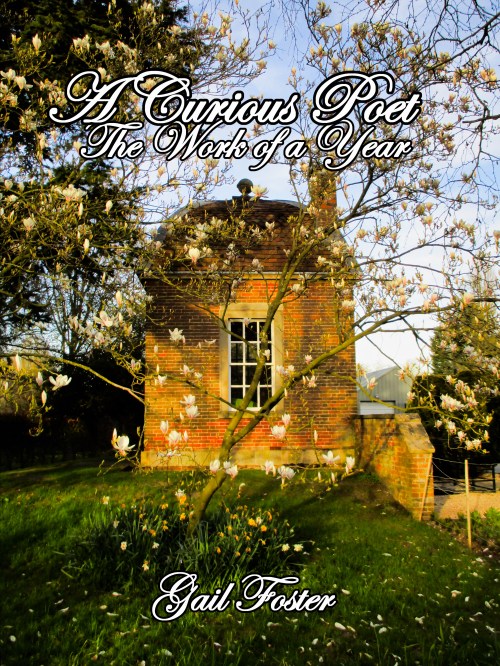
My anthology; A Curious Poet

IMG_0236-10

Today I published my anthology of poetry and prose, ‘A Curious Poet’.

It’s a strange mixture of the spiritual and the mundane, the vulgar and profound.

Some works have already appeared online, and some are as yet unseen.

There’s something to delight or offend pretty much everyone in this book.

My first year as a serious writer has been a wild ride.

Thank you so much for sharing some of it with me.

Best wishes

Gail